
BOPP anti-scratch film mainly protects the film surface by using a hard, crosslinked coating that takes most of the friction and scratching force before it reaches the BOPP substrate or printed layer. In high-performance products, a UV-curable coating is widely used because it can create a dense surface network in a short curing process. Depending on the required finish and performance, manufacturers may also use hybrid UV systems or modify the outer BOPP layer during co-extrusion.
What Is BOPP Anti-Scratch Film?
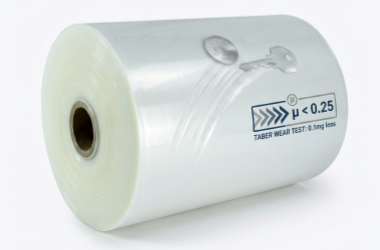
BOPP anti-scratch film is a biaxially oriented polypropylene film designed to improve resistance to surface scratches, scuffs, and repeated handling. BOPP provides good clarity, stiffness, and dimensional stability, but untreated polypropylene has relatively low surface energy and limited surface hardness. A dedicated anti-scratch layer can improve the surface performance without replacing the basic advantages of BOPP.
The product may also be called BOPP Anti-Scratch Film, Scratch-Resistant BOPP Film, Anti-Scratch BOPP Film, or Scratch Resistant BOPP Film.
For matte products, common terms include Scratch-Resistant Matte BOPP Film, Anti-Scratch Matte BOPP Film, and BOPP Anti-Scuff Matte Film. For glossy products, buyers may use Scratch-Resistant Gloss BOPP Film or Anti-Scratch Gloss BOPP Thermal Lamination Film.
These terms usually describe the same basic performance goal: keeping the visible film surface cleaner and more resistant to mechanical damage during handling, transport, lamination, and display.
How Does BOPP Anti-Scratch Coating Work?
The basic working principle is simple: a harder surface layer absorbs and distributes mechanical stress before the force can damage the softer BOPP substrate. When a fingernail, package edge, paper stack, or other object moves across the film, the coating acts as the first protective barrier.
A high-performance coating combines hardness with controlled flexibility. A coating that is only hard but too brittle may crack, while a coating with too much flexibility may not provide enough scratch resistance. The formulation therefore needs a balance between surface hardness, adhesion, flexibility, abrasion resistance, and curing shrinkage.
This balance is especially important for thin films because the coating is usually only a few micrometers thick.
Basic Structure of BOPP Anti-Scratch Film
A typical coated BOPP anti-scratch film consists of a BOPP substrate, a surface treatment layer, and an anti-scratch coating. The exact structure depends on whether the film is designed for dry lamination, thermal lamination, printing, or another converting process.
A simplified structure can be shown as:
BOPP substrate → surface treatment → anti-scratch coating
For a pre-coated thermal lamination film, an additional heat-activated adhesive layer may be used:
BOPP substrate → anti-scratch coating → EVA or other thermal adhesive layer
The BOPP substrate provides the basic mechanical and optical properties. The surface treatment improves adhesion. The anti-scratch coating provides the main surface protection. The thermal adhesive layer allows the film to bond to printed materials during the lamination process.
The coating thickness is commonly in the low-micrometer range, with many formulations falling around 2–5 μm. Actual thickness and dry coating weight vary by formulation, equipment, and performance target.
Why Is Corona Treatment Important?
Corona treatment improves the adhesion between low-surface-energy BOPP and the coating. Polypropylene is chemically non-polar and has relatively low surface energy, so many coating systems do not naturally adhere strongly to an untreated surface.
Corona treatment changes the surface chemistry and increases surface energy. It can introduce more polar groups and improve wetting by the coating. This creates a better interface between the BOPP film and the liquid coating.
Good corona treatment is not only about a higher surface-energy number. Stable and uniform treatment is important because inconsistent treatment can lead to poor wetting, weak adhesion, coating defects, or delamination.
For this reason, surface treatment is a key step before coating high-performance BOPP anti-scratch films.
Main Technology: UV-Curable Anti-Scratch Coating
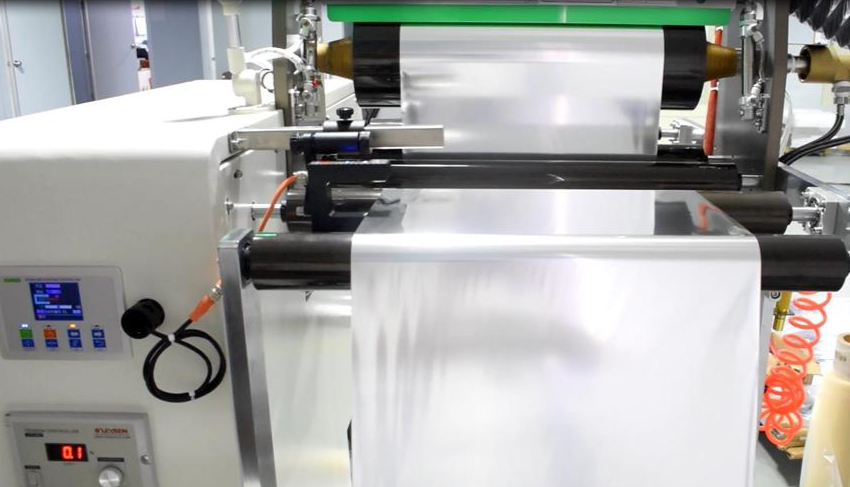
UV-curable coating is one of the main technologies used for high-performance BOPP anti-scratch films because it can form a hard surface network quickly. The coating is applied in liquid form and then exposed to ultraviolet light.
A typical UV system may contain several functional components:
| Component | Main Function |
|---|---|
| Oligomer or resin | Builds the main coating structure and provides toughness |
| Reactive diluent | Reduces viscosity and participates in curing |
| Photoinitiator | Generates reactive species under UV light |
| Nano-silica or other filler | Improves hardness and abrasion resistance |
| Wetting/leveling additives | Improve coating appearance and surface quality |
| Defoamer | Helps reduce foam and coating defects |
Aliphatic polyurethane acrylates are commonly used as important resin components when a balance of toughness, flexibility, adhesion, and wear resistance is required. Their functionality can be adjusted according to the desired hardness and flexibility.
Reactive acrylate diluents can reduce coating viscosity and become part of the cured network. This allows the coating to be processed at a practical viscosity while still achieving a high crosslink density after UV exposure.
Photoinitiators absorb UV energy and generate reactive species that start the curing reaction. The exact photoinitiator package depends on coating thickness, UV wavelength, film speed, pigment or filler content, and other process conditions.
How UV Curing Creates Scratch Resistance
UV curing increases scratch resistance by rapidly converting reactive acrylate groups into a crosslinked polymer network. Under UV radiation, the photoinitiator produces reactive species that initiate polymerization.
A simplified reaction can be represented as:
UV light → photoinitiator activation → free radicals → acrylate polymerization → crosslinked network
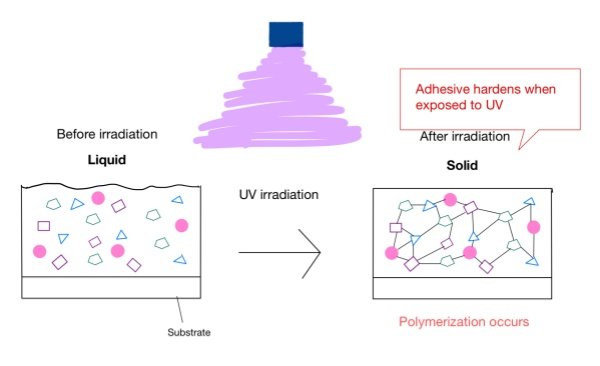
As the crosslinking level increases, the coating generally becomes harder and more resistant to surface deformation.
A high crosslink density can improve resistance to:
- Finger-nail scratching
- Repeated rubbing
- Surface scuffing
- Handling marks
- Abrasion during transportation
- Contact wear during product display
However, maximum crosslink density is not always the best formulation. Excessive crosslinking can reduce flexibility and increase the risk of brittleness or cracking. A good anti-scratch coating therefore needs an optimized network rather than simply the highest possible hardness.
The Role of Nano-Silica
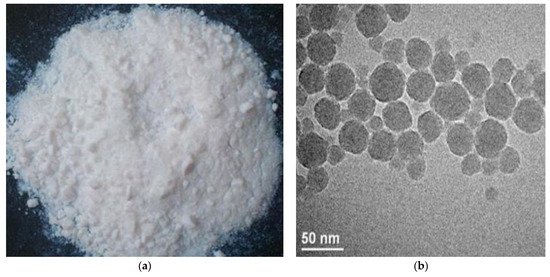
Nano-silica can further improve coating hardness and abrasion resistance when it is well dispersed in the polymer matrix. Small silica particles can reinforce the cured coating and help resist local mechanical deformation.
Surface modification is often used to improve filler dispersion and compatibility with the organic resin system. Silane coupling chemistry may be used for this purpose in suitable formulations.
The final result depends strongly on particle size, surface treatment, loading level, dispersion quality, and resin compatibility. Nano-silica is not automatically beneficial at any concentration because poor dispersion can create haze, agglomeration, surface defects, or reduced flexibility.
For transparent BOPP films, dispersion quality is especially important because optical clarity is often a major product requirement.
Why the Coating Needs Both Hardness and Flexibility
A good BOPP anti-scratch coating must be hard enough to resist scratching but flexible enough to survive film bending and converting. BOPP film is thin and flexible, so a highly brittle coating may crack when the film is bent, folded, wound, or processed.
Polyurethane segments can help provide flexibility and toughness in suitable UV-curable systems. The formulation can then use multifunctional reactive groups to build enough crosslinking for surface hardness.
This creates a key formulation balance:
Hardness + toughness + adhesion + flexibility = practical anti-scratch performance
This is why a coating with a high laboratory pencil hardness value does not necessarily provide the best performance on a finished packaging product.
Advanced Technology: Hybrid Free-Radical and Cationic Curing
Hybrid curing combines different curing mechanisms to balance fast surface hardness with lower shrinkage and better adhesion. In some advanced systems, free-radical curing and cationic curing are combined to form a more complex network.
Free-radical curing can provide fast reaction speed and high surface hardness. Cationic curing can offer lower volumetric shrinkage and good adhesion characteristics in suitable formulations.
The combined system may create an interpenetrating or hybrid network that can help control coating stress.
This approach can be useful for thin matte films and low-warp applications, where coating shrinkage and internal stress can affect film flatness.
Actual performance depends on resin chemistry, photoinitiator package, coating thickness, UV dose, substrate, and process conditions. Therefore, hybrid curing should be evaluated as a formulation strategy rather than a universal requirement.
Why Anti-Scratch Film Helps Protect Printed Graphics
The anti-scratch layer protects printed graphics by moving most surface contact and abrasion away from the ink or printed substrate. When a package is handled repeatedly, scratches and scuffs can gradually reduce gloss, create whitening marks, or damage the visual appearance.
A properly designed anti-scratch layer creates a tougher interface between the external environment and the printed surface.
This is particularly useful for products that experience frequent contact, such as:
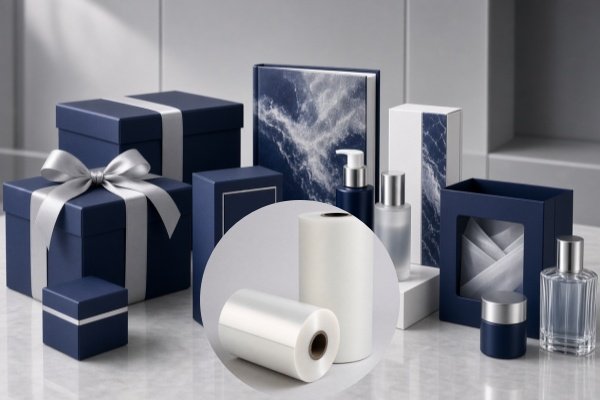
- Premium packaging
- Cosmetics packaging
- Gift boxes
- Book covers
- Printed cartons
- Luxury product packaging
- Retail displays
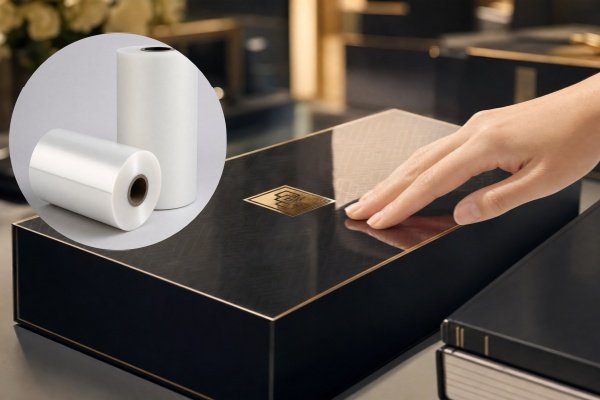
For these applications, scratch resistance is not only a mechanical property but also a visual quality feature. A surface that remains smooth and clean can help maintain the premium appearance of the package.
Matte and Gloss BOPP Anti-Scratch Film
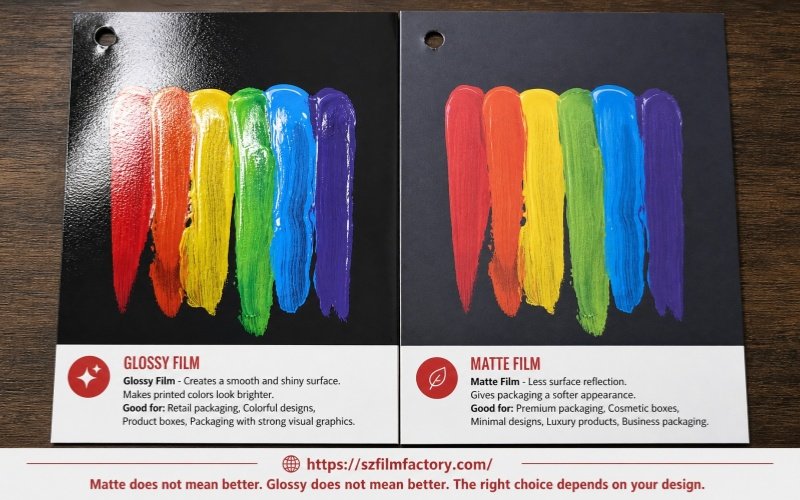
Matte and gloss films can both use anti-scratch technology, but the formulation and surface design may be different. Gloss films focus strongly on optical clarity, gloss retention, and smooth appearance.
Matte anti-scratch films must also control surface texture and haze. The coating needs to protect the textured surface without destroying the intended matte appearance.
This is why Scratch-Resistant Matte BOPP Film and Scratch-Resistant Gloss BOPP Film may require different coating and process designs even when they share the same basic UV-curing principle.
For premium printed packaging, the ideal solution is often a combination of controlled surface texture, stable gloss level, good adhesion, and high scuff resistance.
Co-Extrusion and Modified BOPP Anti-Scratch Technology
Not every scratch-resistant BOPP film uses an external UV coating because some products improve surface performance directly during film manufacturing. In co-extrusion, the outer layer can be modified with different polymers or functional particles.
Possible approaches include:
- Harder polymer phases
- Modified polypropylene
- Fine inorganic particles
- Engineered polymer blends
- Micro-crosslinked surface structures
Matte BOPP films may also use a controlled multi-phase or “sea-island” morphology to create a textured surface and reduce gloss.
The main advantage of co-extrusion is process integration because the surface properties are built into the film during production. The main limitation is that the level of scratch resistance may not match a dedicated high-performance UV coating for demanding applications.
For this reason, coating technology and co-extrusion technology should be selected according to the final application rather than treated as competing solutions in every case.
UV Coating vs. Co-Extrusion Modification
UV coating normally provides greater freedom for high-end surface performance, while co-extrusion can offer a simpler and more integrated film structure.
| Technology | Main Principle | Main Advantage | Typical Positioning |
| UV-curable coating | Dense crosslinked surface network | Strong scratch and abrasion resistance | High-performance packaging |
| Hybrid UV curing | Free-radical + cationic network | Hardness, adhesion, and lower shrinkage balance | Advanced matte or low-warp films |
| Co-extrusion modification | Harder or engineered outer layer | Integrated manufacturing process | General or cost-sensitive applications |
The right technology depends on the required scratch level, appearance, lamination process, production speed, and target cost.
Key Manufacturing Process for Coated BOPP Anti-Scratch Film
A typical coated BOPP anti-scratch film process starts with surface treatment and ends with UV curing and quality inspection.
Step 1: BOPP Film Preparation
The BOPP substrate must have a suitable surface condition before coating. Film cleanliness, surface energy, tension, thickness, and dimensional stability all affect coating quality.
Step 2: Corona Treatment
Corona treatment increases surface energy and supports coating adhesion. Treatment level must remain stable across the production width and throughout production.
Step 3: Coating Application
The UV coating is applied at a controlled coating weight and thickness. Coating uniformity is essential because uneven thickness can cause differences in hardness, appearance, haze, and friction.
Step 4: UV Curing
UV irradiation rapidly converts the liquid coating into a crosslinked protective layer. UV dose, lamp output, line speed, coating thickness, and photoinitiator efficiency all affect final curing quality.
Step 5: Optional Thermal Adhesive Layer
For thermal lamination products, an additional heat-activated adhesive layer can be added to create a ready-to-use thermal lamination film. The adhesive system must remain compatible with the anti-scratch surface and the final lamination process.
Step 6: Quality Inspection
Final performance must be checked through both appearance testing and mechanical testing. Typical evaluation may include scratch resistance, scuff resistance, adhesion, gloss, haze, coefficient of friction, and lamination performance.
What Determines the Performance of BOPP Anti-Scratch Film?
Anti-scratch performance depends on the entire coating system rather than a single raw material. Key factors include resin chemistry, crosslink density, filler dispersion, surface treatment, coating thickness, UV energy, and film quality.
Coating Hardness
Higher surface hardness usually improves resistance to mechanical damage. However, excessive hardness without flexibility can make the coating more brittle.
Crosslink Density
Crosslink density strongly affects the final surface network and wear resistance. A higher level can improve hardness, but the optimum value depends on the full formulation.
Adhesion
Strong adhesion between the coating and BOPP is essential for durable scratch resistance. A hard coating can still fail if it separates from the substrate.
UV Curing
Complete curing is critical because under-cured coatings may have lower hardness and poorer chemical and abrasion resistance. UV dose should therefore be controlled rather than judged only by line speed.
Filler Dispersion
Uniform nano-particle dispersion is important for both mechanical performance and optical quality. Agglomeration can create visible defects and weaken the coating.
Surface Design
A controlled matte or gloss surface changes the way scratches and scuffs are seen. Optical appearance should therefore be evaluated together with mechanical performance.
How to Choose the Right BOPP Anti-Scratch Film
The best BOPP anti-scratch film should be selected according to the final converting process and end-use conditions. A film for premium cosmetic packaging may have different requirements from a film for book covers or standard printed packaging.
Before selecting a film, consider:
What level of scratch resistance is required? Light handling may need basic scuff resistance, while luxury packaging may require a stronger protective surface.
Is the product matte or gloss? The coating must maintain the intended appearance after curing and lamination.
Will the film be thermal laminated? The anti-scratch surface and thermal adhesive layer must work together without reducing flatness or surface performance.
How important are clarity and haze? Transparent applications require strong control of filler dispersion and coating uniformity.
Does the package experience repeated handling? Frequent contact makes abrasion and scuff resistance more important.
Does the application require low warping? Thin films and matte applications may benefit from coating systems designed to control curing stress.
For a product designed around premium packaging, it is often useful to compare film samples under the same printing and lamination conditions instead of relying on a single laboratory value.
Need help matching a BOPP anti-scratch film to your application? Contact Shunzhan New Materials to discuss film structure, finish, and performance requirements.
BOPP Anti-Scratch Film vs. Traditional BOPP Film
The main difference is surface performance rather than the basic role of the BOPP substrate. Standard BOPP can provide good stiffness, clarity, and dimensional stability, while an anti-scratch version adds a more durable protective surface.
| Property | Standard BOPP | BOPP Anti-Scratch Film |
| BOPP substrate | Yes | Yes |
| Surface hardness | Standard | Enhanced |
| Scratch resistance | Standard | Enhanced |
| Scuff resistance | Standard | Enhanced |
| Premium surface protection | Limited | Stronger |
| High-end packaging suitability | Application dependent | Often preferred |
Actual performance varies by film construction and testing method, so product data should always be compared under consistent test conditions.
Common Questions About BOPP Anti-Scratch Film
What is BOPP anti-scratch film?
BOPP anti-scratch film is a polypropylene film with improved resistance to scratches and surface scuffs. High-performance versions often use a UV-curable protective coating on a treated BOPP substrate.
Is BOPP anti-scratch film always coated?
No, not always. Some scratch-resistant films use a surface coating, while others improve surface performance through co-extrusion and polymer or particle modification.
Why is UV coating widely used for high-performance BOPP film?
UV coating can create a highly crosslinked protective layer quickly. This makes it suitable for applications that require strong surface hardness and high production efficiency.
What is the role of corona treatment?
Corona treatment improves surface energy and coating wetting on BOPP. This helps the coating adhere more reliably to the substrate.
Does a harder coating always mean better anti-scratch performance?
No. A good anti-scratch coating needs a balance of hardness, flexibility, toughness, adhesion, and curing shrinkage.
Can BOPP anti-scratch film be used for thermal lamination?
Yes, suitable products can be designed for thermal lamination. A thermal adhesive layer, such as an EVA-based system in some constructions, may be added to the film.
What is the difference between anti-scratch and anti-scuff?
Anti-scratch usually focuses on resistance to deeper surface damage, while anti-scuff often emphasizes resistance to visible rubbing and abrasion marks. In commercial film specifications, the terms can overlap.
Why Choose Shunzhan New Materials for BOPP Film Solutions?
Shunzhan New Materials focuses on BOPP and PET film solutions for demanding converting and packaging applications. Our product range includes functional film solutions such as anti-scratch film and other specialty surfaces designed for different appearance and performance requirements.
For customers developing premium printed packaging, the right film should be evaluated as part of the complete system, including printing, lamination, surface appearance, scratch resistance, and final converting conditions.
Explore our BOPP anti-scratch film solutions through the relevant product page, or contact our team to discuss your required finish and application.
Choose the Right BOPP Anti-Scratch Film for Your Application
BOPP anti-scratch film works by combining a suitable BOPP substrate with a harder protective surface that can withstand repeated mechanical contact. UV-curable coating is a major high-performance route because it can rapidly form a dense crosslinked network with a strong balance of hardness and flexibility.
For demanding matte and gloss thermal lamination applications, coating chemistry, surface treatment, curing conditions, and film structure all need to be optimized together. This system-level approach is what turns a standard BOPP film into a high-performance scratch-resistant packaging material.
Looking for the right Scratch-Resistant BOPP Film for your next project? Contact Shunzhan New Materials at info@szfilmfactory.com, send us your application requirements through our contact form, or request a quotation for a suitable film solution.