
BOPP film needs a stable corona level above 38 dyne/cm to achieve reliable ink adhesion, because low surface energy prevents ink from properly bonding with the film surface. When corona treatment weakens over time, printers may see problems such as ink peeling, poor print quality, uneven colors, and customer complaints. Understanding corona decay and controlling surface energy are key steps for stable BOPP printing performance.
For BOPP film manufacturers, converters, and printers, corona treatment is not just a production step. It is a critical surface modification process that directly affects printing results.
Shunzhan New Materials produces high-quality BOPP and PET films with controlled surface treatment performance to help customers reduce printing failures and improve production efficiency.
Need BOPP film with stable corona performance? Contact Shunzhan New Materials for technical support.
What Is Corona Treatment and Why Does It Matter in BOPP Printing?
Corona treatment improves BOPP film surface energy so ink can spread and bond effectively.
BOPP (Biaxially Oriented Polypropylene) film has excellent strength, transparency, and moisture resistance. However, polypropylene is naturally a low surface energy material. Its chemical structure makes it difficult for printing inks, coatings, and adhesives to attach directly.
Corona treatment uses high-voltage electrical discharge to change the film surface. The process creates polar groups on the film surface and increases surface energy.
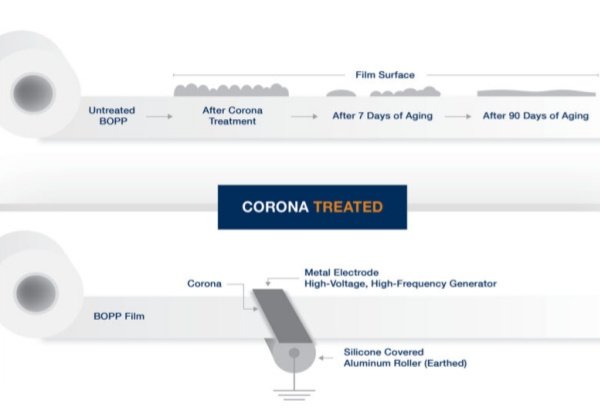
A higher surface energy allows:
- Better ink wetting
- Stronger ink adhesion
- More uniform printing
- Better coating performance
- Reduced ink failure risks
For BOPP printing applications, a corona level of 38 dyne/cm or higher is generally recommended because this level provides a safer surface condition for most printing inks.
Why Must BOPP Corona Levels Stay Above 38 Dyne/cm?
Maintaining corona levels above 38 dyne/cm helps ensure stable ink bonding and prevents printing defects.
The dyne level represents the surface energy of the film. A higher dyne value means the film surface is easier for liquids like ink and adhesive to wet.
When the corona value drops below 38 dyne/cm:
- Ink may not spread evenly
- Ink layers may become weak
- Printed images may lose sharpness
- Ink can scratch or peel easily
- Adhesive strength may decrease during lamination
The problem is that BOPP film does not always lose corona performance immediately. A film may show good corona treatment right after production but experience surface energy loss during storage and transportation.
This is called corona decay or corona aging.
Key Fact:
BOPP film requires stable surface energy because polypropylene naturally has low polarity. Corona treatment increases surface polarity, but the effect can decrease over time due to molecular migration and surface recovery.
What Causes Corona Retention Loss in BOPP Film?
Corona retention decreases because the treated surface gradually returns toward its original low-energy state.
Several factors can accelerate corona decay:
1. Molecular Migration
Additive migration is one of the main reasons BOPP corona levels decrease over time.
BOPP films often contain additives such as slip agents and anti-block agents. These materials can move from inside the film toward the surface.
When additives cover the treated surface:
- Surface polarity decreases
- Ink wetting becomes weaker
- Dyne levels drop
This is why a BOPP roll may print well immediately after production but fail after several months of storage.
2. Storage Time
Long storage periods can reduce BOPP surface energy.
Corona treatment is not permanent. The dyne level usually decreases gradually after treatment.
Factors affecting storage decay include:
- Film formulation
- Initial corona strength
- Storage temperature
- Humidity conditions
- Packaging protection
Proper storage management is important for maintaining printing performance.
3. Low Initial Corona Treatment
Insufficient corona treatment during production creates unstable printing performance later.
If the film leaves production with a borderline corona value, even small surface changes can push it below the required level.
For example:
- Initial corona: 39 dyne/cm
- After storage loss: 36–37 dyne/cm
The film may then show poor ink adhesion.
At Shunzhan New Materials, production control focuses on stable corona treatment levels to reduce performance changes during customer use.
How to Detect Corona Decay in BOPP Film
Regular dyne testing is the most effective way to identify corona loss before printing problems occur.
The most common testing method is the dyne pen test.
Dyne Pen Test
Dyne pens provide a quick method to check whether the BOPP surface can accept ink properly.
The testing process is simple:
- Clean the film surface
- Apply dyne solution to the film
- Observe the liquid behavior
- Check whether the line remains continuous
If the liquid breaks into small droplets quickly, the surface energy is too low.
A stable continuous line indicates better wetting performance.
Contact Angle Testing
Contact angle measurement provides a more accurate analysis of BOPP surface energy.
This method measures how a liquid drop behaves on the film surface.
A smaller contact angle usually means:
- Better surface wetting
- Higher surface energy
- Better ink adhesion potential
This test is often used for laboratory quality control and product development.
Test Before Printing
Testing corona levels before printing prevents expensive production failures.
Converters should check:
- Incoming BOPP rolls
- Long-stored materials
- Different production batches
- Materials used for high-quality printing
Early detection helps avoid:
- Waste printing rolls
- Machine downtime
- Customer complaints
Need help checking BOPP corona performance? Contact Shunzhan New Materials for professional film recommendations.
How to Fix Low Corona Retention Problems in BOPP Printing
Low corona problems can be solved through proper film selection, surface treatment control, and production adjustments.
1. Use Fresh Corona-Treated BOPP Film
Using recently treated film reduces the risk of surface energy loss.
For sensitive printing applications, avoid using old inventory without testing.
Recommended actions:
- Check production date
- Test dyne level before printing
- Use proper storage conditions
2. Apply Online Corona Treatment Before Printing
Additional corona treatment before printing can restore surface energy.
Many printing lines include corona treatment units before printing stations.
This can improve:
- Ink adhesion
- Coating uniformity
- Printing stability
However, excessive corona treatment should be avoided because it may damage the film surface or create other quality issues.
3. Choose BOPP Film Designed for Printing
Printing-grade BOPP film provides better corona retention and more stable performance.
A high-quality printing BOPP film should have:
- Controlled additive formulation
- Stable surface treatment
- Consistent dyne level
- Good aging resistance
Shunzhan New Materials provides BOPP and PET films for printing, packaging, and lamination applications with customized solutions.
How Shunzhan New Materials Helps Prevent BOPP Printing Failures
Shunzhan New Materials focuses on producing BOPP and PET films with reliable surface performance and consistent quality control.
Our production process focuses on:
- Stable corona treatment
- Controlled film formulation
- Quality inspection
- Customer application support
We understand that film performance is not only about appearance. Surface properties directly affect your printing efficiency and final product quality.
Whether you need BOPP film for flexible packaging, labels, lamination, or printing applications, stable corona retention is essential.
Looking for reliable printing-grade BOPP film? Get in touch with Shunzhan New Materials for technical advice.
Frequently Asked Questions About BOPP Corona Retention
What is the ideal corona level for BOPP printing?
A corona level above 38 dyne/cm is commonly recommended for stable BOPP printing performance.
Some applications may require higher levels depending on ink type, coating system, and printing method.
How long does corona treatment last on BOPP film?
Corona treatment can decrease over time, and the retention period depends on film formulation, storage conditions, and treatment level.
Always test stored film before printing.
Can low corona levels cause ink peeling?
Yes, low corona levels can cause weak ink adhesion, resulting in peeling, scratching, and poor print quality.
The ink cannot properly wet and bond with a low-energy BOPP surface.
Improve Your BOPP Printing Reliability with Shunzhan New Materials
Stable corona retention starts with choosing the right BOPP film supplier and controlling surface energy throughout the process. If your BOPP film shows ink adhesion problems, low dyne values, or inconsistent printing results, Shunzhan New Materials can help analyze your application and recommend suitable BOPP or PET film solutions.
Contact our team at info@szfilmfactory.com for technical consultation, request a Get a Quote through our contact form, or arrange a factory visit to learn more about our film production capabilities.
Choose Shunzhan New Materials for reliable BOPP and PET films designed for better printing performance, stronger adhesion, and stable production results.