
Why BOPP Works Well for Adhesive Tape?
BOPP offers high tensile strength, good clarity, moisture resistance and low cost. These properties make it the standard backing for carton sealing and packaging tapes worldwide.
The film provides a stable base for acrylic or hot-melt adhesives. After proper surface treatment it holds the adhesive firmly during coating, slitting and use.
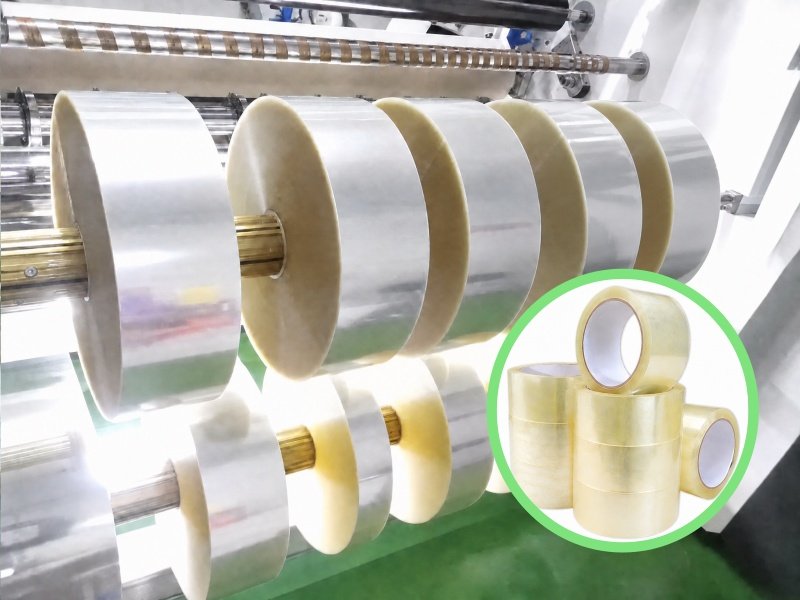
Typical BOPP Film Specifications for Adhesive Tape
A tape-grade BOPP film should be evaluated by several specifications, not thickness alone. The following values are common reference points for BOPP film used in pressure-sensitive adhesive tape.
| Property | Typical Range / Reference | Why It Matters |
|---|---|---|
| Thickness | 20–60 μm | Controls tape strength, flexibility, and material cost |
| Thickness tolerance | ±2–3.5% | Affects coating and converting consistency |
| Density | 0.90–0.91 g/cm³ | Used for weight and yield calculations |
| Tensile strength, MD | ≥135–160 MPa | Important for machine-direction strength |
| Tensile strength, TD | ≥260–305 MPa | Important for cross-direction strength |
| Elongation, MD | 150–180% | Shows how the film stretches before breaking |
| Elongation, TD | 50–65% | Important for tape handling and converting |
| Surface tension | ≥38 dyn/cm | Supports adhesive coating and wetting |
| Haze | ≤1–2% | Lower haze gives better clarity |
| Gloss | ≥90% | Supports a clear and attractive tape surface |
| Coefficient of friction | 0.35–0.50 | Affects film handling and rewinding |
| Heat shrinkage, MD | ≤3.5–5% | Lower shrinkage improves dimensional stability |
| Heat shrinkage, TD | ≤1–3% | Helps control width and shape changes |
These are general industry reference values, not guaranteed specifications for every BOPP grade. Actual values depend on film thickness, formulation, production technology, and the intended adhesive tape application. Public tape-film TDS documents show similar ranges, including 20–50 μm and 25–50 μm products with surface tension around 38 dyn/cm and tensile strength above 150 MPa in the MD direction.
1. BOPP Film Thickness: 20–60 μm
Thickness determines the basic structure and cost of the finished adhesive tape. BOPP tape films are commonly available from about 20 μm to 60 μm, while 25–50 μm is a useful range for many general packaging tape applications. Public tape-film specifications also show common grades around 23, 25, 28, and 30 μm.
A simple selection guide is:
- 20–25 μm: lightweight tape and applications where material efficiency is important.
- 25–30 μm: common range for lighter packaging and general-purpose tape.
- 30–40 μm: suitable when more backing strength and handling stability are required.
- 40–50 μm: often used for stronger packaging tape.
- 50–60 μm: useful when higher film thickness and robustness are required.
Thickness should be selected together with the adhesive coating weight. A thicker BOPP film does not automatically produce a better tape if the adhesive system is not matched to it.
2. Tensile Strength: Aim for 150+ MPa MD
Tensile strength shows how much force the BOPP film can withstand before breaking. For tape-grade BOPP, a practical reference is around 150 MPa or higher in MD and 260–300 MPa or higher in TD.
MD means machine direction, while TD means transverse direction.
For example, published tape-film data include 160 MPa MD and 305 MPa TD at 20 μm thickness. Other tape-film specifications list ≥150 MPa MD and ≥260 MPa TD.
For general packaging tape, 150 MPa+ MD tensile strength is a useful starting point. If the tape must handle higher tension during application or converting, a higher-strength film may be preferred.
3. Elongation: About 150–180% MD
Elongation describes how much the film can stretch before breaking. Tape-grade BOPP commonly shows around 150–180% MD elongation and 50–65% TD elongation.
One published 20 μm tape-grade BOPP film reports 155% MD and 55% TD elongation. Other tape-film TDS data specify MD elongation up to 180% and TD up to 65%.
Elongation should be considered together with tensile strength. A film with the right balance can run smoothly during coating, slitting, and tape application.
4. Corona Treatment: 38–42 dyn/cm
Surface tension is one of the most important specifications when BOPP film will be coated with adhesive. Untreated polypropylene has relatively low surface energy, so surface treatment is normally required to improve coating wetting and adhesion.
For adhesive tape applications, 38 dyn/cm is a common minimum reference, while 38–42 dyn/cm is a practical target range for many coated BOPP applications.
Public tape-film TDS data show corona treatment around 38–39 dyn/cm.
A higher initial dyne level does not always mean better long-term performance. Treatment retention is also important because surface tension can decrease during storage.
For this reason, tape manufacturers should check both the initial treatment level and the recommended storage conditions.
5. Haze: Preferably Below 2%
Haze affects how clear the finished adhesive tape looks. For transparent packaging tape, a practical target is generally ≤2% haze, with premium clear applications often looking for even lower values.
Published tape-film specifications include haze values around 0.8–2.0%, depending on the film grade and thickness.
Choose lower haze when visual clarity is important. This is especially relevant for clear carton sealing tape and printed tape where the appearance of the backing film affects the final product.
6. Gloss: Around 90–95%
Gloss affects the visual appearance of the tape backing. A tape-grade BOPP film with around 90–95% gloss can provide a bright and clean surface for clear and printed tape applications.
Public BOPP tape-film data commonly show gloss values around 90% or higher, with some 20 μm film data reaching approximately 94%.
7. Coefficient of Friction: About 0.35–0.50
Coefficient of friction affects how the film moves through converting and rewinding equipment. A typical reference range for BOPP tape film is around 0.35–0.50.
For example, published data show COF values of approximately 0.40–0.45, while some tape-film specifications use ≤0.50 as a reference.
The right COF depends on your equipment. Too much friction can affect film handling, while very low friction can also create problems during certain converting processes.
8. Heat Shrinkage: Keep It Low
Low heat shrinkage helps maintain dimensional stability during tape production. A common reference for BOPP tape film is around ≤3.5–5% in MD and ≤1–3% in TD, depending on the test temperature and test method.
For example, published tape-film data report MD shrinkage around 3.5% and TD shrinkage around 1% under specified test conditions. Other specifications list maximum values of 3.5% MD and 2% TD.
Always compare shrinkage data using the same test conditions. Temperature and test time can change the result, so a number without its test method is not enough for a technical comparison.
What BOPP Film Thickness Is Best for Packing Tape?
For general carton sealing tape, 25–50 μm is a practical starting range for BOPP backing film. The exact thickness depends on the required tape strength, adhesive coating weight, roll length, application method, and target cost.
For example:
| Application | Suggested Starting Thickness |
|---|---|
| Lightweight packaging tape | 20–25 μm |
| General packaging tape | 25–40 μm |
| Medium-duty carton sealing tape | 40–50 μm |
| Heavy-duty applications | 50–60 μm |
These ranges are starting points rather than fixed standards. The final tape construction should be tested with the selected adhesive.
What Surface Tension Is Needed for Adhesive Coating?
A surface tension of at least 38 dyn/cm is a common starting point for BOPP film used with pressure-sensitive adhesive coatings. Many tape-grade products specify around 38–39 dyn/cm, while some applications may require a different treatment level based on the adhesive formulation.
Water-based acrylic, solvent-based, and hot-melt adhesive systems can behave differently. Therefore, the film supplier and adhesive supplier should confirm the required surface condition together.
If you already know your adhesive type, share it with Shunzhan New Materials when requesting a film recommendation.
How to Choose BOPP Film for Your Tape
The best film is the one that matches the complete tape construction, not simply the film with the highest specification.
Check these points before placing an order:
- Tape application: carton sealing, stationery, printing, or specialty tape.
- Film thickness: commonly 20–60 μm.
- MD tensile strength: preferably around 150 MPa or higher for general tape applications.
- TD tensile strength: commonly 260–300 MPa or higher.
- MD elongation: around 150–180%.
- TD elongation: around 50–65%.
- Corona treatment: around 38–42 dyn/cm.
- Haze: preferably ≤2% for clear tape.
- Gloss: around 90–95% for a clear, bright appearance.
- COF: around 0.35–0.50.
- Heat shrinkage: check both MD and TD values under the same test conditions.
- Converting performance: confirm that the film runs well on your coating and slitting equipment.
BOPP Film for Adhesive Tape from Shunzhan New Materials
Shunzhan New Materials produces BOPP and PET films, including BOPP film suitable for adhesive tape manufacturing. We can provide film options based on the required thickness, surface treatment, mechanical properties, and converting process.
For tape manufacturers, technical data should be reviewed before selecting a grade. Our website also provides a Film TDS page where you can check available film specifications and compare technical parameters.
If you need a specific thickness or surface treatment, you can also send your requirements to our team for evaluation.
Get a BOPP Film Recommendation for Your Tape
Give us your tape requirements and we can help you identify a suitable BOPP film specification. Tell us the target thickness, adhesive type, tape application, and required roll width if available.
Contact Shunzhan New Materials at info@szfilmfactory.com or use our contact form to request a quotation and technical information. If you would like to evaluate the material in person, you are also welcome to discuss a factory visit with our team.
FAQ
What is the most common BOPP film thickness for adhesive tape?
25–50 μm is a practical range for many packaging tape applications, while thinner 20–25 μm and thicker 50–60 μm films are also available for specific requirements.
Is 38 dyn/cm enough for adhesive tape coating?
38 dyn/cm is a common starting point for many adhesive coating applications, but it should not be treated as a universal requirement. The actual target depends on the adhesive formulation and coating process.
What is a good tensile strength for tape-grade BOPP film?
Around 150 MPa or higher in MD and 260–300 MPa or higher in TD is a useful reference for many tape applications. Actual requirements depend on film thickness and tape construction.
Does thicker BOPP film always make stronger tape?
No. Final tape strength also depends on adhesive strength, coating weight, film orientation, and the complete tape structure.
How long can corona-treated BOPP film be stored?
Surface treatment can decline during storage. Storage conditions therefore matter. One BOPP tape-film manufacturer recommends keeping film below 30°C and below 70% RH when longer storage is required to help minimize treatment decay.
Should BOPP tape film be tested before mass production?
Yes. A laboratory TDS cannot fully predict performance on every coating and slitting line. A production trial is recommended to confirm coating adhesion, winding, slitting, and finished tape performance.
What information should I provide when asking for BOPP tape film?
Provide at least the target thickness, tape application, adhesive type, coating method, required width, and expected performance. This information helps the film supplier recommend a more suitable grade.
Can Shunzhan New Materials provide BOPP film for custom tape applications?
Yes. Shunzhan New Materials focuses on BOPP and PET film production and can discuss suitable BOPP film options for different adhesive tape applications. Contact us with your technical requirements to discuss the available options.