
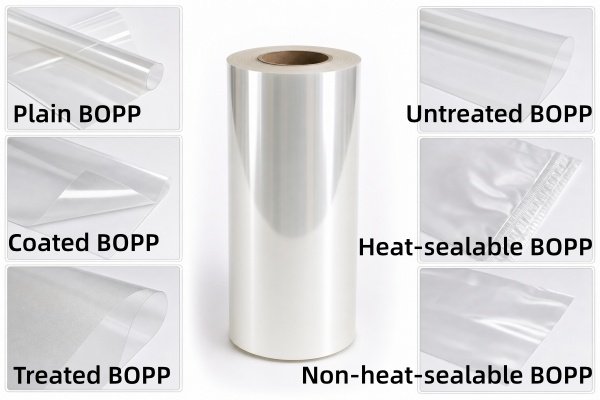
BOPP film is not a single type of film; it can be classified by surface finish, coating, surface treatment, and heat-sealing performance. The most common terms include plain BOPP, coated BOPP, treated BOPP, untreated BOPP, heat-sealable BOPP, and non-heat-sealable BOPP. These terms describe different properties, and one BOPP film can belong to more than one category at the same time.
For example, a film can be plain and treated, or coated and heat-sealable. Understanding this difference helps buyers choose the correct BOPP film for printing, lamination, packaging, labeling, and other converting processes.
What Is BOPP Film?
BOPP stands for Biaxially Oriented Polypropylene. It is a polypropylene film stretched in both the machine direction and transverse direction to improve its physical properties.
BOPP film is widely used because it offers a good balance of clarity, stiffness, strength, moisture resistance, and printability. It is commonly used in flexible packaging, labels, lamination, overwrap, and industrial applications.
The final performance of BOPP film depends on more than the base material. Film structure, orientation, surface treatment, coating, thickness, and sealing properties can all affect the final application.
In simple terms, BOPP film is a versatile base film that can be modified for different converting and packaging requirements.
BOPP Film Classification at a Glance
The easiest way to understand BOPP film types is to classify them by the property being described.
| Classification | What it describes | Typical purpose |
|---|---|---|
| Plain BOPP | Basic film surface or structure | Printing, lamination, general converting |
| Coated BOPP | Film with an additional coating | Special surface or functional performance |
| Treated BOPP | Surface has been treated | Better ink, adhesive, or coating adhesion |
| Untreated BOPP | Surface has no such surface treatment | Applications where treatment is not required |
| Heat-sealable BOPP | Designed to seal under heat | Packaging that needs direct heat sealing |
| Non-heat-sealable BOPP | Does not provide a heat-sealing layer | Lamination and applications using another sealing layer |
These categories can overlap. For example, plain BOPP can be corona treated, while a coated BOPP can also have heat-sealing properties.
1. Plain BOPP Film
Plain BOPP film is a basic BOPP film without a special functional coating or decorative surface finish.
The word “plain” does not mean that the film is untreated. It usually describes the film as a standard or basic BOPP structure rather than a film with a special coating, matte effect, or other functional layer.
Plain BOPP can be transparent and glossy, depending on the film grade and production process. It is commonly selected as a base film for printing, lamination, labeling, and other converting processes.
A plain BOPP film may still receive corona treatment on one or both sides. Therefore, “plain” and “untreated” should not be treated as opposite terms.
Common applications of plain BOPP
Plain BOPP film can be used for:
- Flexible packaging
- Lamination
- Printing
- Labels
- Overwrap
- General converting applications
Choose plain BOPP when you need a standard film structure and do not need a special surface coating.
If you are looking for a BOPP film for a specific printing or lamination process, you can also explore our BOPP film products to find a suitable film grade.
2. Coated BOPP Film
Coated BOPP film has an additional coating applied to the film surface to provide a specific function or surface property.
The coating can change how the film interacts with ink, adhesive, heat, light, or the surrounding environment. The exact performance depends on the coating material and coating process.
Coated BOPP can be designed for applications where standard BOPP does not provide the required surface performance.
Why use coated BOPP?
A coating may be used to improve or add properties such as:
- Printability
- Ink adhesion
- Adhesive compatibility
- Heat-sealing performance
- Surface appearance
- Barrier performance
- Special tactile or functional effects
The term “coated” does not describe one specific product. Different coatings are developed for different applications.
For example, a coating designed for high-quality printing is different from a coating designed for heat sealing.
Coated vs. plain BOPP
The main difference is simple:
Plain BOPP is a basic film structure, while coated BOPP has an additional coating designed to provide specific surface or functional properties.
For applications that require special surface performance, a coated film may be a better choice than standard BOPP.
3. Treated BOPP Film
Treated BOPP film has a modified surface that improves adhesion to inks, coatings, or adhesives.
Polypropylene has relatively low surface energy. This can make it difficult for some inks and adhesives to bond strongly to untreated film.
A common solution is corona treatment.
Corona treatment uses electrical discharge to modify the film surface. This can increase surface energy and improve the interaction between the film and materials applied to it.
Why is BOPP film treated?
Treated BOPP is commonly used when the film needs to work with:
- Printing inks
- Adhesives
- Coatings
- Lamination systems
For example, a printer may need treated BOPP because ink needs to wet and adhere properly to the film surface.
Treated BOPP does not always mean coated BOPP
Treatment and coating are different processes.
Surface treatment modifies the surface of the existing film. Coating adds another material or layer to the surface.
This distinction is important when selecting film for printing or lamination.
4. Untreated BOPP Film
Untreated BOPP film has not received a surface treatment such as corona treatment on the specified surface.
Untreated BOPP generally has lower surface energy than treated BOPP. As a result, inks, adhesives, and coatings may have difficulty bonding to the surface without additional preparation.
However, untreated film can still be useful in applications where direct printing or coating is not required.
It may also be used as part of a multilayer structure where another layer provides the required adhesion or functional performance.
Treated vs. untreated BOPP
The basic difference is surface condition:
| Feature | Treated BOPP | Untreated BOPP |
|---|---|---|
| Surface treatment | Yes | No |
| Surface energy | Usually higher | Usually lower |
| Ink adhesion | Generally better | Generally more difficult |
| Adhesive bonding | Generally easier | May require additional treatment |
| Typical use | Printing and lamination | Applications without direct printing/coating |
The correct choice depends on what will contact the BOPP surface during converting.
When ordering BOPP film, buyers should confirm which side is treated and the required surface treatment level, rather than only asking whether the film is “treated.”
5. Heat-Sealable BOPP Film
Heat-sealable BOPP film is designed to form a seal when heat and pressure are applied under suitable sealing conditions.
This type of film is useful for packaging structures that need the film itself to participate in the sealing process.
Many heat-sealable BOPP films use a multilayer structure. The sealing layer is designed to soften and form a bond at the required sealing temperature.
Where is heat-sealable BOPP used?
Common applications include:
- Flexible food packaging
- Snack packaging
- Overwrap
- Bags and pouches
- Packaging structures that require heat sealing
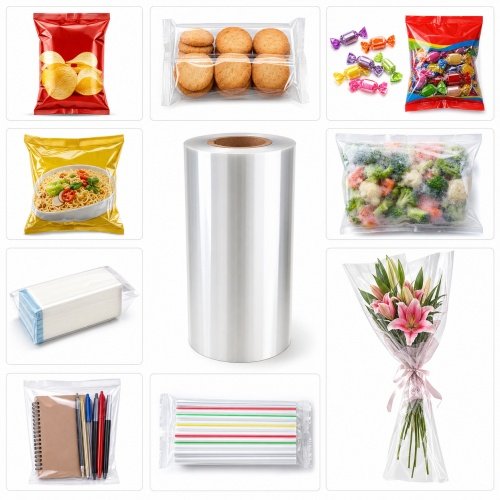
Heat-sealable BOPP can simplify packaging design because the film can provide both the main film properties and the sealing function.
However, sealing performance depends on more than the film name. Sealing temperature, pressure, dwell time, sealing layer, packaging machine, and film structure can all affect the final seal.
For this reason, buyers should select a film based on the actual packaging process rather than choosing a film only because it is labeled “heat-sealable.”
6. Non-Heat-Sealable BOPP Film
Non-heat-sealable BOPP film is generally used when the BOPP layer itself does not need to provide the final heat seal.
This does not mean that a package made with non-heat-sealable BOPP cannot be heat sealed.
Instead, another layer in the packaging structure may provide the sealing function.
For example, BOPP can be laminated with another film that has suitable heat-sealing properties. In this structure, the BOPP layer can provide properties such as stiffness, clarity, printability, or appearance, while another layer provides the seal.
Why use non-heat-sealable BOPP?
Non-heat-sealable BOPP can be suitable for:
- Lamination
- Printed packaging structures
- Label applications
- Structures where another layer provides heat sealing
- Applications where direct heat sealing of BOPP is not required
The key point is that non-heat-sealable BOPP is not necessarily “less useful”; it is designed for a different packaging structure.
Plain vs. Coated BOPP: What Is the Difference?
Plain BOPP is a basic film structure, while coated BOPP contains an additional coating for a specific surface or functional requirement.
Plain BOPP is often selected when the converter needs a standard film for printing, lamination, or general processing.
Coated BOPP is more suitable when the surface needs additional functionality.
The right choice depends on the next processing step.
For example:
- For standard converting → plain BOPP may be suitable.
- For special printing requirements → coated BOPP may be considered.
- For special surface performance → a functional coating may be required.
- For lamination → the correct surface treatment or coating is important.
Do not choose between plain and coated BOPP based only on appearance. Check the required converting process first.
Treated vs. Untreated BOPP: What Is the Difference?
The main difference between treated and untreated BOPP is the condition of the film surface, especially its ability to accept inks, coatings, or adhesives.
Treated BOPP is commonly preferred for printing and lamination because surface treatment can improve adhesion.
Untreated BOPP may be suitable when no direct printing, coating, or adhesive bonding is required on that surface.
One important point is that surface treatment can change over time. Storage conditions, contamination, and film age can affect surface performance.
For demanding printing or lamination applications, converters should confirm the supplier’s recommended treatment level and test the film under actual production conditions.
Heat-Sealable vs. Non-Heat-Sealable BOPP
The key difference is whether the film structure is designed to provide a heat-sealing function.
Heat-sealable BOPP normally includes a sealing layer or structure that can create a seal under suitable heat, pressure, and time conditions.
Non-heat-sealable BOPP does not normally provide that direct sealing function. It can instead be combined with another heat-sealable material.
The choice depends on the packaging machine and the complete packaging structure.
Quick comparison
| Property | Heat-Sealable BOPP | Non-Heat-Sealable BOPP |
|---|---|---|
| Direct heat sealing | Yes, under suitable conditions | No, normally |
| Sealing layer | Usually included | Usually not included |
| Typical use | Heat-sealed packaging | Printing, lamination, and multilayer structures |
| Main selection factor | Sealing performance | Converting and lamination requirements |
How BOPP Film Types Can Overlap
BOPP classification terms describe different aspects of the film, so one film can have several classifications at the same time.
This is one of the most important points when buying BOPP film.
For example:
Plain + Treated + Non-Heat-Sealable
This could describe a standard BOPP film that has a treated printing surface but does not provide a direct heat-sealing function.
Another film could be:
Coated + Treated + Heat-Sealable
This could describe a film with a functional coating, surface treatment, and sealing structure.
Therefore, it is not correct to think of plain, coated, treated, untreated, heat-sealable, and non-heat-sealable as six completely separate BOPP product groups.
They describe different characteristics of the same film.
How to Choose the Right BOPP Film
The best BOPP film should be selected according to the final application, converting process, and required performance.
Start with the final use instead of starting with the film name.
1. Check the final application
Ask where the film will be used.
Is it for:
- Food packaging?
- Labels?
- Lamination?
- Printing?
- Overwrap?
- Industrial packaging?
- Decorative applications?
The application determines the basic film requirements.
2. Check whether printing is required
If the film will be printed directly, surface treatment is usually an important consideration.
The required treatment depends on the ink, printing method, and production conditions.
3. Check whether lamination is required
If BOPP will be laminated, the surface must be compatible with the selected adhesive and lamination process.
A treated or specially coated surface may be required depending on the structure.
4. Check whether heat sealing is required
If the BOPP film must form the package seal, choose a suitable heat-sealable grade.
If another layer provides the seal, a non-heat-sealable BOPP may be suitable.
5. Check the required appearance
Clarity, gloss, matte appearance, and surface feel can also affect film selection.
For applications that require a special visual or tactile effect, a standard plain BOPP film may not be enough.
6. Check thickness and mechanical properties
Film thickness and mechanical performance should match the converting process and end-use requirements.
Important factors can include:
- Thickness
- Tensile strength
- Elongation
- Stiffness
- Shrinkage
- Clarity
- Gloss
- Coefficient of friction
- Surface treatment
- Seal strength
A film supplier should be able to provide the technical data needed for your application.
BOPP Film Selection Checklist
A clear specification makes BOPP film sourcing faster and reduces the risk of choosing the wrong film.
Before requesting a quotation, prepare the following information:
- Film type: Plain, coated, or functional film
- Surface: Treated or untreated
- Heat sealing: Heat-sealable or non-heat-sealable
- Application: Printing, lamination, packaging, labeling, etc.
- Thickness: Required film thickness
- Width: Required roll width
- Core size: Required core specification
- Printing method: If applicable
- Lamination method: If applicable
- Final packaging structure: If applicable
The more complete the specification, the easier it is for a film manufacturer to recommend the correct grade.
Frequently Asked Questions About BOPP Film
Is plain BOPP the same as untreated BOPP?
No. Plain BOPP and untreated BOPP describe different characteristics. Plain usually refers to a standard film structure without a special functional coating or surface effect. Untreated refers to the absence of a specified surface treatment. A plain BOPP film can still be treated.
Is coated BOPP better than plain BOPP?
Not necessarily. Coated BOPP is designed for additional functionality, while plain BOPP can be the better choice for applications that do not require a special coating. The correct film depends on the application.
Can treated BOPP be used for printing?
Yes. Treated BOPP is commonly used for printing because surface treatment can improve ink adhesion. The actual result depends on the treatment level, ink system, printing process, and storage conditions.
Can non-heat-sealable BOPP be used for packaging?
Yes. Non-heat-sealable BOPP can be part of a multilayer packaging structure. Another layer can provide the heat-sealing function.
What is the difference between BOPP and heat-sealable BOPP?
Standard BOPP does not necessarily provide direct heat sealing, while heat-sealable BOPP is designed with a sealing structure that can form a seal under suitable conditions.
Which BOPP film is best for lamination?
The best BOPP film for lamination depends on the adhesive, lamination process, printing requirements, and final packaging structure. In many cases, surface treatment is an important factor because the adhesive needs sufficient adhesion to the film.
Why Choose the Right BOPP Film Supplier?
A reliable BOPP film supplier should help you match film properties with your actual converting process.
At Shunzhan New Materials, we focus on BOPP and PET film solutions for different converting and packaging needs. Our product range includes functional films such as touch-feel film, anti-scratch film, anti-fingerprint film, and multifunctional films.
For BOPP applications, the right choice is not only about selecting a film name. It is about matching the film structure, surface condition, coating, treatment, and final performance to your application.
If you are unsure whether you need plain, coated, treated, untreated, heat-sealable, or non-heat-sealable BOPP, our team can help you review the application and film requirements before you place an order.
Get the Right BOPP Film for Your Application
Tell us your application, required thickness, width, surface treatment, and heat-sealing requirements, and we can help you identify a suitable BOPP film solution.
You can contact Shunzhan New Materials at info@szfilmfactory.com, request a quotation through our contact form, or contact our team to discuss your BOPP film requirements.
If you are looking for a long-term film supplier, you are also welcome to visit our factory and discuss your requirements with our team.